RESEARCH
Making Complex Science Understandable
Teaching has been one of the most rewarding aspects of my academic career. For more than two decades, I have taught students at different stages of their education, from undergraduates to master’s and Ph.D. students, as well as future physicians and dentists.
My goal has always been the same: to make complex scientific concepts understandable, meaningful, and memorable.

Teaching Across Disciplines
My teaching spans pharmacology, physiology, neuroscience, behavioral pharmacology, addiction science, biostatistics, and research methods.
Working with students from different academic and professional backgrounds has continually challenged me to find new ways of explaining scientific concepts and connecting them to real-world applications.
A Teaching Journey from Palermo to Boston
My teaching experience began in 2001 at the University of Palermo, Italy, where I taught undergraduate pharmacology and related disciplines.
During my doctoral training at Sapienza University of Rome, I also taught neuropsychopharmacology at the graduate level.
Since joining Boston University in 2009, I have taught extensively across graduate, medical, and dental programs, contributing to the education of students pursuing a wide range of scientific and healthcare careers.

Understanding, Not Just Memorizing
My teaching philosophy is simple: truly learning something means understanding why it happens, rather than merely remembering that it happens.
I use intuitive explanations, visual representations, and active problem-solving to help students recognize connections between concepts and apply their knowledge to unfamiliar situations.
Courses & Academic Leadership
Over the past two decades, my teaching has spanned a broad range of disciplines, including pharmacology, psychopharmacology, behavioral pharmacology, neuroscience, addiction science, human physiology, and biostatistics. I have taught undergraduate, master’s, Ph.D., medical, and dental students, adapting complex scientific concepts to different educational and professional backgrounds.
Beyond classroom teaching, I have directed and co-directed several graduate courses at Boston University, contributing to curriculum development, assessment, and innovative educational approaches. My selected course directorships include:
Introduction to Medical Pharmacology (2022–present)
Behavioral Pharmacology (2010–2022)
Current Topics in Pharmacological Sciences (2020–2024)
Technical and Professional Skills in Pharmacology (2022–2026)
My teaching also emphasizes the development of practical scientific and professional skills, including experimental design, critical evaluation of research, scientific communication, and grant writing. Through activities such as mock NIH grant-review study sections, I encourage students to move beyond acquiring knowledge toward applying it critically and independently.
What My Students Say
Student feedback has been one of the most meaningful aspects of my teaching career. I am especially grateful when students describe not only enjoying a course, but also gaining a deeper understanding of challenging scientific concepts.
Clear explanations
“makes complicated topics very easy to follow”
Care for students
“cares about his students”
Understanding over memorization
“It is not about mugging up but understanding the material.”
Recognition for Teaching Excellence
In 2023, I received the Graduate Medical Sciences Faculty Recognition Award from Boston University Chobanian & Avedisian School of Medicine.
This recognition holds particular significance for me because teaching has always been a central part of my academic identity.
I consider the opportunity to help students develop deeper understanding of science one of the greatest privileges of an academic career.
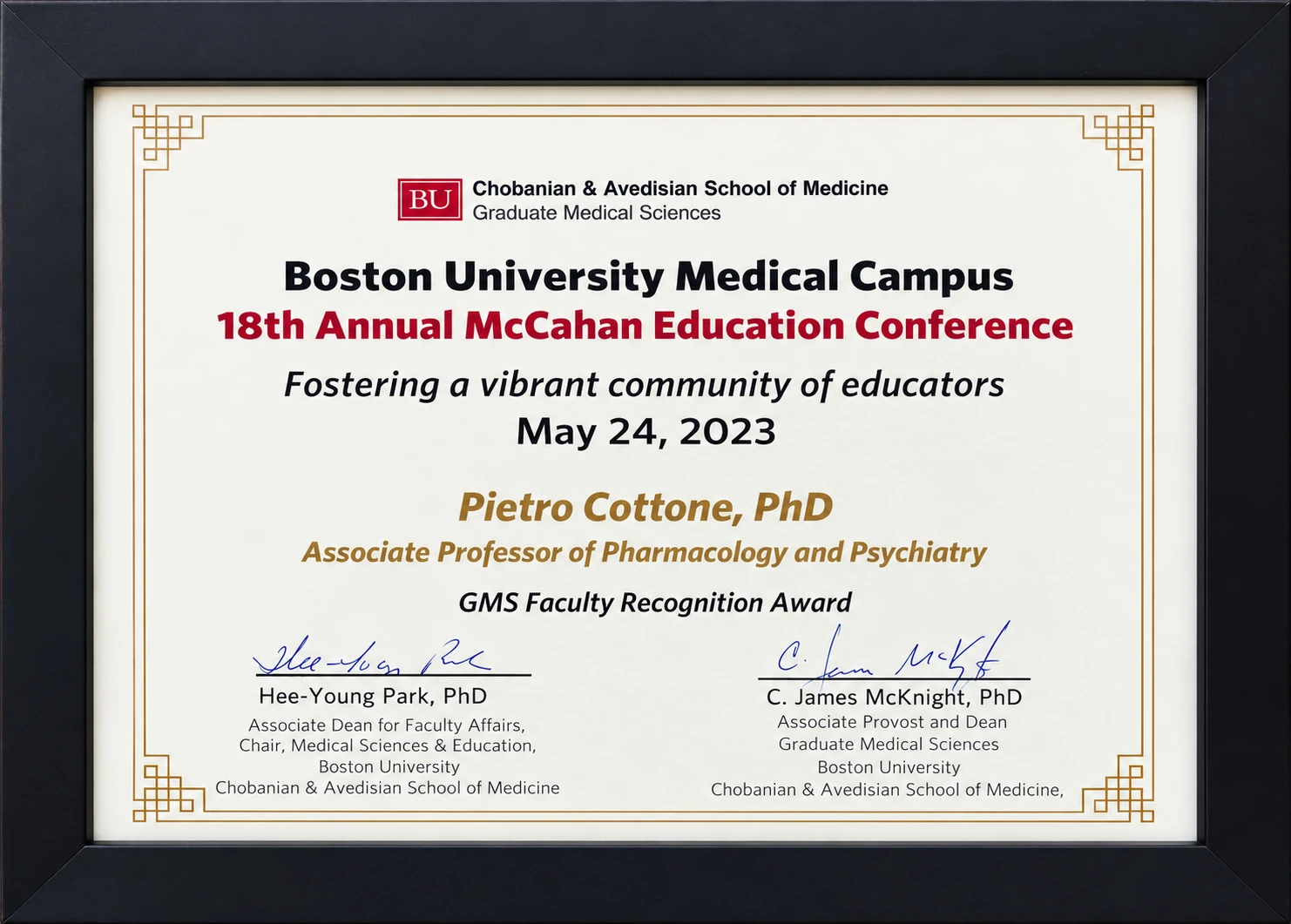
2023 GMS Faculty Recognition Award
This distinction recognizes contributions to graduate education and reflects my longstanding commitment to creating meaningful learning experiences.